
MMA
What is MMA? How striking, wrestling and ground fighting fit together
Why a boxer has to think about takedowns, and why a familiar grappling position changes once punches are possible.
3 min read
Read articleMMA
MMA did not emerge from one encounter or one person's idea. Its history brings together different competition cultures, technical experiments and rules. The decisive development was learning to connect skills while an opponent tried to separate them.
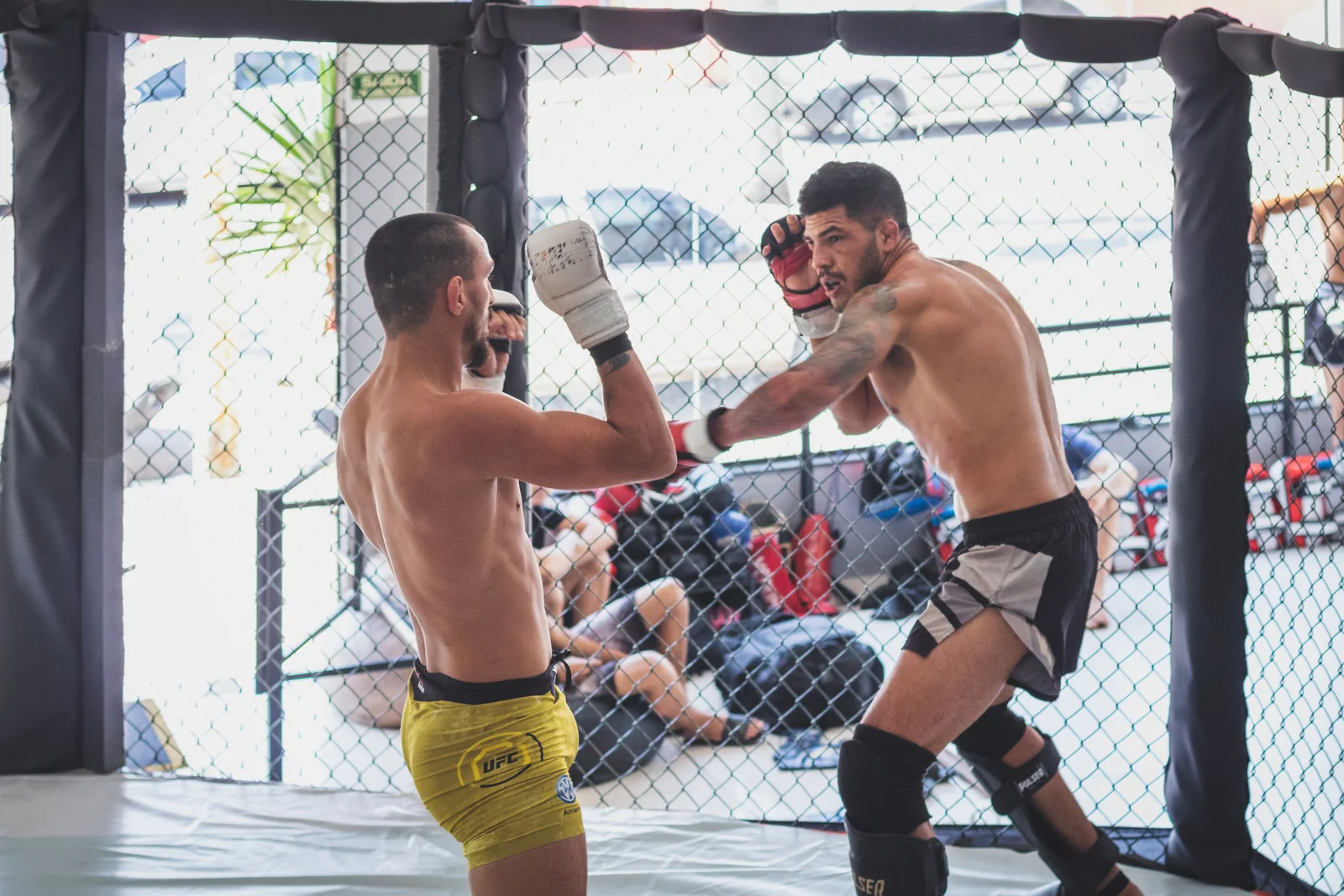
Could a boxer beat a wrestler? Such questions gave early mixed contests an understandable story. Each discipline brought a distinct answer: striking at distance, throwing from a clinch or controlling someone on the ground. The comparison became less tidy when competitors could change those situations. A punch depended on what preceded it; a takedown also depended on what followed.
Several different histories sit inside that story. A contest allowing strikes and wrestling is a mixed rules contest. A challenge between representatives of different disciplines is an interstyle encounter. A hybrid method deliberately combines tools, while cross-training means learning outside your original discipline. Modern MMA adds an organised sporting framework, with identifiable rules, officials and competition pathways. These categories overlap, but treating them as interchangeable obscures how the sport developed.
There is therefore no single birth date that explains everything. The useful historical question is how athletes learned to manage the gaps between their skills, and how organisers made those encounters repeatable. What began as a comparison of styles increasingly became a comparison of integrated performances: who could establish the distance, change the position and keep making useful decisions when the other person resisted?
Ancient Greek pankration combined boxing and wrestling, as the Metropolitan Museum of Art explains in its account of Greek athletics. It demonstrates that competing across striking and grappling is an old idea. People were testing several forms of unarmed combat within an athletic setting long before contemporary promotions, televised tournaments or the familiar cage existed.
That resemblance should remain a historical comparison. Ancient competitors lived within different institutions, social expectations and sporting conventions. A surviving description or image does not give us a complete modern training syllabus. Nor does the existence of an older mixed contest establish an uninterrupted chain of teachers leading to today's MMA. Similar practical problems can appear in different places without every later solution descending directly from the earliest recorded example.
Pankration makes the opening question more interesting: why has combining skills repeatedly seemed useful? Distance can close, balance can break and a standing exchange can become a struggle on the ground. Those possibilities create a technical relationship between striking and wrestling. The ancient example reveals the age of that relationship; understanding the modern sport still requires examining the much later competitions, training networks and regulatory decisions that shaped it.
Cross-disciplinary ideas also circulated outside tournaments. In a 1901 interview, Edward William Barton-Wright described Bartitsu through boxing, wrestling, Japanese jujutsu and stick methods. He raised a recognisable issue: effectiveness at one distance may leave questions when an opponent closes it. The interview documents an intentional combination of skills, although its promotional confidence cannot establish effectiveness against every opponent.
Catch wrestling contributed another set of wrestling and submission tools. It is more useful to recognise those tools than to imagine one uniform global catch ruleset. Different venues and traditions could organise competition differently. A submission demonstrated cooperatively, a negotiated challenge and a result recorded in a newspaper provide different kinds of information. None automatically tells us how a technique would perform throughout a modern MMA contest with its particular equipment and restrictions.
Research by Lise and Capraro also documents Japanese jiu-jitsu activity in Brazil before the familiar exclusive Maeda-to-Gracie origin story, including Sada Miyako's exhibitions in 1908. Such records make room for travelling teachers, local practitioners and audiences. They show a broader environment of encounters without turning every exhibition into competitive proof. Modern integration grew within that wider history of skills moving between people and places.
Brazil's vale tudo culture is central to modern MMA. The phrase is often rendered as anything goes, but it does not imply a literal absence of agreements or boundaries. Encounters took place in varied settings and conditions. Understanding a contest means asking what participants had agreed, which actions were available and how a winner could be determined.
The broader Brazilian history matters here. Newspaper-based research challenges a clean narrative in which one teacher passed knowledge to one family and thereby created every later form of mixed combat. Gracie-associated challenges became influential, but they existed within a setting where other practitioners and disciplines also met. Keeping that wider view prevents historical importance from becoming an exclusive claim of ownership over a complex sporting and technical development.
A permissive encounter exposes unfamiliar problems: the striker may face a takedown, while the grappler must close distance under threat of punches. It does not isolate style as the only variable. Preparation, size, experience and knowledge of the agreed conditions also influence what happens. Vale tudo helped make those problems visible. Its enduring contribution is easier to understand through the questions it forced practitioners to answer than through slogans about unrestricted fighting.
The Gracie family's practice and promotion gave Brazilian Jiu-Jitsu an important role in public discussions of fighting. Position, control and submissions offered an answer to a stronger opponent or a comfortable striker. Brazilian combat culture also included no-gi grappling, submission wrestling, Luta Livre and striking disciplines. Its development requires attention to practitioners beyond one family or training tradition.
Research drawing on oral histories and documents examines Rio de Janeiro's rivalries in the 1980s and 1990s, including connections between Muay Thai and Luta Livre practitioners. Rivalry can encourage technical exchange, even when participants describe themselves as opponents. Violence outside sporting settings deserves a different judgement: it is no model for a training culture. A useful historical account can recognise conflict without presenting intimidation or uncontrolled confrontations as evidence of good coaching.
Different practice conditions also produce different habits. Clothing changes available grips; removing strikes allows more attention to some grappling exchanges; adding them changes posture and urgency. Those differences help explain adaptation without declaring one system permanently superior. A specialist discipline can develop valuable depth, while a mixed contest asks how that depth survives changed conditions. Learning across the boundary becomes more informative than defending the reputation of a label.
Bruce Lee's estate identifies 1967 as the year Jeet Kune Do received its name. Its account emphasises simplicity, directness, freedom and evolving personal expression. That outlook addresses a recurring difficulty: once a method becomes an identity, practitioners can become more concerned with preserving its shape than with examining the problem in front of them.
The connection is conceptual. Lee did not establish the modern MMA competition system, and philosophical openness alone does not explain the later creation of Shooto, Pancrase or the UFC. Film performances are also a different form of evidence from resisted practice or competition. His significance here lies in articulating an approach to learning that could cross disciplinary boundaries, not in supplying a missing institutional link between every older martial art and today's sport.
Adaptation still needs a way to distinguish useful changes from attractive ideas. Borrowing a throw or a punching combination is only a first step. Can you reach its starting position against resistance, and can you deal with the opponent's next response? A mixed training environment turns those questions into observable tasks. The philosophy encourages enquiry; realistic practice determines what the borrowed skill contributes under the conditions being tested.
On 26 June 1976, Muhammad Ali and Antonio Inoki met at Tokyo's Nippon Budokan. Their contest ended in a draw after fifteen rounds, with Inoki often kicking from the floor. The image remains familiar, but the special rules are essential. An encounter between famous specialists tests the abilities that its permitted interaction allows them to use.
The limited engagement illustrates why rule design matters technically. If one athlete can avoid the other's preferred range while still using a permitted action, the contest may develop around that asymmetry. That observation requires no disputed story about secret negotiations or dramatic injuries. It simply means that a spectacle framed as a clash of styles must be assessed through its particular constraints, rather than treated as a universal verdict on boxing or wrestling.
Japanese professional wrestling provides another part of the background. Its technical traditions included submission skills, and shoot-style presentation later foregrounded the appearance of realistic combat. Presentation and legitimate competition nevertheless remain distinct. Professional wrestling matches are not all unscripted contests, while competitive shoot events require their own identification and records. Maintaining that distinction explains a technical lineage without confusing entertainment conventions with the evidence produced by an independently contested result.
The Japanese Shooto Association dates Satoru Sayama's creation of Shooto to 1984, amateur competition to 1986 and professional competition to 1989. These milestones correct accounts that begin organised mixed combat entirely with the UFC. Creation, amateur participation and professional events need not share one date; another historical account may emphasise a different milestone in the system's early development.
The more useful point is institutional. A repeatable sport needs more than two willing opponents and a dramatic challenge. Rules, refereeing, licensing and an amateur-to-professional route provide a structure through which participants can prepare, compete and progress. That structure influences what coaches teach and what athletes expect. An amateur experience can introduce competition demands within its own conditions rather than simply reproducing a professional event at a smaller scale.
Shooto therefore helps explain how mixed competition could become a practice community. Athletes could develop against known expectations, and their experience could inform subsequent training. This does not require a claim that one promotion was the world's first in every possible sense. It shows that Japan had an organised route towards mixed sporting competition before the American event that would later become its most widely recognised public reference point.
Pancrase held its first event on 21 September 1993 at Tokyo Bay NK Hall, before UFC 1. Associated with Masakatsu Funaki and Minoru Suzuki, it emerged from a professional wrestling lineage; its official record lists Ken Shamrock defeating Funaki by submission. Different organisers were already testing competitive combinations through different formats before the sport gained its familiar American reference point.
Early Pancrase used conditions that differ from today's familiar Unified Rules. Its original head-striking approach relied on palm strikes rather than closed-fist punches, and rope escapes were part of the framework. Those details matter because the available actions and escape mechanisms change decisions. A position near the ropes can have a different meaning from the same body arrangement in open space, while restrictions on striking affect how athletes connect contact and control.
The historical comparison is therefore richer than asking whether the event looked sufficiently like contemporary MMA. A format can provide meaningful competitive information while testing a different task. Athletes prepare for what an event actually permits, and organisers can revise those conditions over time. Pancrase's early rules reveal one route through the problem of combining grappling and striking, rather than an incomplete copy of a future ruleset everyone already knew.
UFC 1 took place in Denver on 12 November 1993. Royce Gracie won its eight-person main tournament, submitting Art Jimmerson, Ken Shamrock and Gerard Gordeau. Rorion Gracie, Art Davie and SEG helped bring a televised style-comparison concept to the audience. The event made grappling problems especially visible to viewers who understood fighting mainly through punches and kicks, and it became a powerful reference point for later discussions of MMA.
Its format differed sharply from today's standard presentation. There were no weight classes or current five-minute-round structure. The no-rules marketing was also an exaggeration: restrictions included biting and eye gouging. That combination made the event unusual, but it did not remove conditions altogether. Nor should its particular arrangements be projected across every early UFC event; the organisation's formats and restrictions changed as its competition and regulatory circumstances developed.
The entrants were selected representatives, not a random sample in a controlled experiment. Their preparation, technical overlap and familiarity with other disciplines varied. Ken Shamrock's earlier Pancrase appearance alone complicates a story of sealed styles meeting for the first time. UFC 1 supplied an influential set of results under specified circumstances. The challenge for practitioners was to learn from those results without turning a successful tournament performance into a permanent ranking of all martial arts.
Royce Gracie's first UFC win demonstrated the relevance of controlling and submitting opponents. The revealing feature was the relationship between positions: entering from standing, establishing a useful ground situation and finishing without winning a conventional striking exchange. The result exposed problems that a fighter trained exclusively at distance might not have learnt to recognise or solve.
An opponent's unfamiliarity is part of that explanation. If you do not understand the danger of a position, you may respond in ways that make it worse or miss an available escape. That does not establish that BJJ always defeats every other discipline. The event cannot separate style from each entrant's experience and preparation, and later learning changes the question. Wrestlers can develop submission awareness; strikers can practise preventing takedowns and returning to their feet.
Grappling literacy means recognising those threats and options even when grappling is not your preferred way to win. A successful specialist may need only enough knowledge to avoid becoming trapped in an unfamiliar exchange, but that knowledge must function against resistance. Royce's impact thus extends beyond encouraging people to study one discipline. It helped make the absence of a range visible, which gave athletes a concrete reason to adapt their training.
Vale Tudo Japan on 29 July 1994, won by Rickson Gracie, connected Brazilian grappling with Japan's mixed competition environment. PRIDE's first event followed at the Tokyo Dome on 11 October 1997, where Rickson defeated Nobuhiko Takada by armbar. These events reflect an international exchange of competitors, promoters and audiences, alongside Japan's existing institutions and distinct presentation.
The ring also created a different physical setting from a cage. Ropes, corners and referee intervention affect how movement and grappling develop at the boundary. Later archived PRIDE rules commonly used an initial ten-minute round followed by two five-minute rounds, prohibited elbows to the head or face, and conditionally allowed knees and kicks to a grounded opponent's head. These are features of the later documented rules, not a description of every first-event arrangement in 1997.
Such differences complicate direct comparisons between competitors and eras. A position that offers a useful pause under one ruleset may expose an athlete to a legal attack under another; a longer opening round can change how activity is distributed. Technique still matters, but it operates within that environment. PRIDE's history demonstrates how mixed combat could develop a recognisable sporting identity while retaining conditions that differed from those familiar to a UFC audience.
The first response to an unfamiliar range is often defensive. A striker learns wrestling to remain standing; a wrestler learns submission defence to retain top control; a grappler learns to enter under striking pressure. These additions protect a specialist's preferred game while changing it: familiar actions now sit beside an opponent's option to create another kind of exchange.
Over time, MMA training increasingly treated those connections as skills in their own right. An athlete could learn a punch together with the takedown threat it conceals, or a ground position together with its routes to striking, submission and standing up. That is different from attending several separate classes and expecting integration to happen automatically. The difficult moment is often the handover: a good combination finishes, distance closes, and the next decision arrives before a comfortable reset.
This was a gradual development rather than a change on one universally agreed date. It also did not make specialist knowledge obsolete. High-level boxing, wrestling and grappling can still supply depth that a broad syllabus lacks. Integration asks which parts of that depth transfer, which require adjustment and how to connect them. Modern fighters can share the same sporting framework while retaining distinctly different preferences, rhythms and ways of creating opportunities.
A boxing stance needs assessment within MMA. Weight distribution, head movement and punching commitment interact with an opponent's ability to change level or close into a clinch. The answer varies between fighters. Assess a choice through its consequences: what does it help you create, and which response does it make easier for the other person?
Kicks introduce a related trade-off. They can manage distance or create an opening, but the moment of contact is only part of the action. Recovery, balance and the possibility of a catch affect what follows. A kickboxing combination can be technically sound within its original task and still require a different exit when the opponent may wrestle. Practising that exit under appropriate resistance makes the connection visible without dismissing the original skill.
Muay Thai's clinch knowledge offers valuable ways to manage posture and close contact. MMA adds further questions about body locks, takedowns, the boundary and available grips. A useful adaptation connects those possibilities rather than assuming that entering the clinch always produces the same exchange. Striking in MMA is therefore partly the study of what a strike invites: a retreat, a counter, a grab or a change in level, each requiring another decision.
A wrestling entry changes when the opponent can punch or threaten a guillotine. Approach, head position and completion must fit the larger exchange. Striking can create an entry by drawing attention or changing posture, while a takedown threat can alter striking defence. Drilling an isolated movement and practising its use inside MMA therefore ask related but distinct questions.
Ground positions change meaning too. In sport BJJ, a guard can support extended attempts to off-balance, sweep or submit. In MMA, posture and striking access also influence whether remaining underneath is useful. Getting up may become the better goal even when a submission remains conceivable. This does not make guard work irrelevant; understanding its controls and openings helps an athlete judge what is available and how the presence of punches changes the priorities.
Top position similarly asks for more than simply arriving above an opponent. Control must accommodate movement, striking and possible submission transitions. Committing both hands to an action can change the base; pursuing a finish can create space for an escape. Ground and pound is therefore connected to positional knowledge, not a separate activity added after wrestling ends. The historical shift towards integration becomes concrete in these ordinary decisions about what the position can actually support.
Against a cage, retreat can end before a striking exchange does, and wall contact can change a takedown. Underhooks, head position and balance help manage that contact. An athlete needs to recognise when the wall provides support and when it restricts escape. In open space, those relationships change because movement is less constrained.
Wall walks and mat returns illustrate the competing aims. One athlete wants to build posture and stand; the other wants to interrupt that process and maintain control. A useful practice task can begin at that decision point and allow partners to pursue opposing goals under agreed conditions. It does not need to reproduce an entire fight to reveal why a movement works, where it fails or which connection is missing.
Using the cage as a structural boundary differs from grabbing the fence, which written rules prohibit. Rope boundaries and possible resets create other conditions again. A competition surface therefore deserves explicit attention when evaluating a technical example or historical performance. The sport's physical setting helps shape its solutions, and an apparently universal technique may depend on a boundary, grip or referee procedure unavailable in the event being considered.
New Jersey records identify a 3 April 2001 meeting in Trenton at which representatives agreed uniform MMA rules. This regulatory milestone involved multiple contributors and subsequent adoption decisions. Weight categories, equipment, fouls, rounds and officials defined competition more consistently. Injury remained possible, while athletes, coaches, organisers and regulators gained clearer conditions to prepare for and administer.
Those conditions continue to change. The ABC's 2024 revisions addressed the downward elbow prohibition and the definition of a grounded fighter, with implementation depending on jurisdiction. Its August 2026 document also contains changes approved that month with a requested implementation date in November 2027. Approval and present enforcement are different facts. Reading a current document therefore requires attention to effective dates and the rules adopted for the particular event.
Judging shapes priorities alongside legality. The ABC's 2025 clarification emphasises productive offence and damage rather than treating holding time as an achievement by itself. Technically, gaining a position and using it effectively remain connected questions. An athlete can win access without producing much from it, while another can create meaningful offence in less time. Understanding the actual scoring criteria makes a performance easier to assess than relying only on who appeared to control the location.
Brazil, Japan, the United States and Europe contributed different training communities and competitive routes. Travelling athletes brought techniques, preparation habits and expectations about rules. Coaches learnt through unfamiliar approaches too. This network helps explain technical development alongside the influence of local institutions, which continued to shape how participants entered and progressed within MMA.
Amateur organisation became another part of that development. IMMAF was founded in Sweden on 29 February 2012 and held its first world championships in 2014. These milestones illustrate an international institutional pathway; they do not make MMA an Olympic sport. An amateur framework has its own purpose and conditions. Its value cannot be judged simply by how closely a particular event resembles the most visible professional promotion.
Professional preparation also brings more work around the technical session: strength and conditioning, nutrition, recovery, opponent analysis and game planning. Their practical role is to help organise preparation for a defined task, rather than to substitute for skill. A plan still has to meet a resisting opponent. The modern environment supports narrower areas of expertise while requiring people to connect them, much as the athlete connects striking, clinching and ground work inside the contest.
MMA's history encourages exploring every important range. You can retain a specialism while recognising situations an opponent can create and developing responses that function at your current level. Athletic ability supports those responses, alongside understanding why a position is dangerous or which action creates space. Specialist depth remains useful when connected to the wider task.
Resistance provides a way to investigate that connection. Cooperative drills can introduce a pattern; a demonstration can make it easier to see. Positional work and sparring then ask whether the pattern remains useful when a partner pursues another goal. Conditions should match the question and the participants' experience. A successful example supports a conclusion within that setting, rather than proving that the technique works against every opponent in every environment.
MMA is one sporting test, and self-defense involves additional problems: surprise, weapons, other people, the environment and the possibility of escape. Sporting success cannot guarantee safety there. Traditional practices may also have cultural, recreational or fitness purposes that an MMA result does not measure. Respecting those purposes is compatible with examining combat claims carefully. The sensible standard is clear context and observable performance, without mystical explanations or hostility towards entire traditions.
The timeline connects people combining skills, organisers arranging encounters and institutions defining repeatable competition. Pankration offers an ancient comparison, Bartitsu describes a hybrid method, and Brazilian and Japanese settings create later opportunities. The UFC gives particular mixed contests exceptional visibility. Understanding what each milestone represents clarifies their relationships without forcing them into one uninterrupted succession.
The technical thread is the changing value of unfamiliarity. A specialist can expose an opponent's missing knowledge; that opponent, or the next generation, can learn to recognise the same problem. Integration therefore develops through repeated adjustment. The question becomes less about which discipline owns an effective action and more about how an athlete reaches it, preserves its usefulness and responds when the first attempt does not produce the intended outcome.
The institutional thread remains open too. Rules, surfaces, amateur pathways and scoring affect what competitors must solve, and those conditions can vary between jurisdictions and events. Contemporary MMA is consequently both a recognisable sport and a continuing learning process. Its history is useful because it explains why transitions deserve deliberate practice: the decisive action often begins in one range, depends on another and succeeds only when the opponent's response is understood.
Ancient Greece
Boxing and wrestling meet in an ancient athletic contest: a historical comparison, rather than a direct genealogy of modern MMA.
1901
Barton-Wright describes a hybrid self-defense method in an interview, combining several disciplines outside a modern MMA competition framework.
Early twentieth century
Documented interstyle activity predates the exclusive Gracie origin narrative and reveals a broader environment of travelling practitioners and local encounters.
1967
Bruce Lee articulates an adaptable approach to learning; this is a conceptual contribution, rather than the founding of MMA institutions.
26 June 1976
Their specially arranged contest in Tokyo ends in a draw and demonstrates how conditions shape an encounter between specialists.
1984 / 1986 / 1989
The Japanese association identifies creation, amateur competition and professional competition as separate milestones.
21 September 1993
The Tokyo event offers another competitive format combining grappling and striking before UFC 1.
12 November 1993
The Denver tournament gives style comparison and submission grappling a highly visible public reference point.
29 July 1994
Rickson Gracie wins the event within Japan's developing international mixed competition environment.
11 October 1997
The first event extends Japan's mixed combat scene, with Rickson Gracie defeating Nobuhiko Takada by armbar.
3 April 2001
The New Jersey meeting establishes an important regulatory agreement without creating instant worldwide adoption.
2012 / 2014
IMMAF's founding and first world championships mark developments in an international amateur pathway.
Present
Athletes connect striking, clinching and ground work while rules continue to evolve; event conditions and jurisdiction still matter.
Skill First
Want to explore a question from this article on the mat? Find a suitable training option or discuss where you would like to start.
Discuss your questionExplore the question from another angle.
MMA
Why a boxer has to think about takedowns, and why a familiar grappling position changes once punches are possible.
MMA
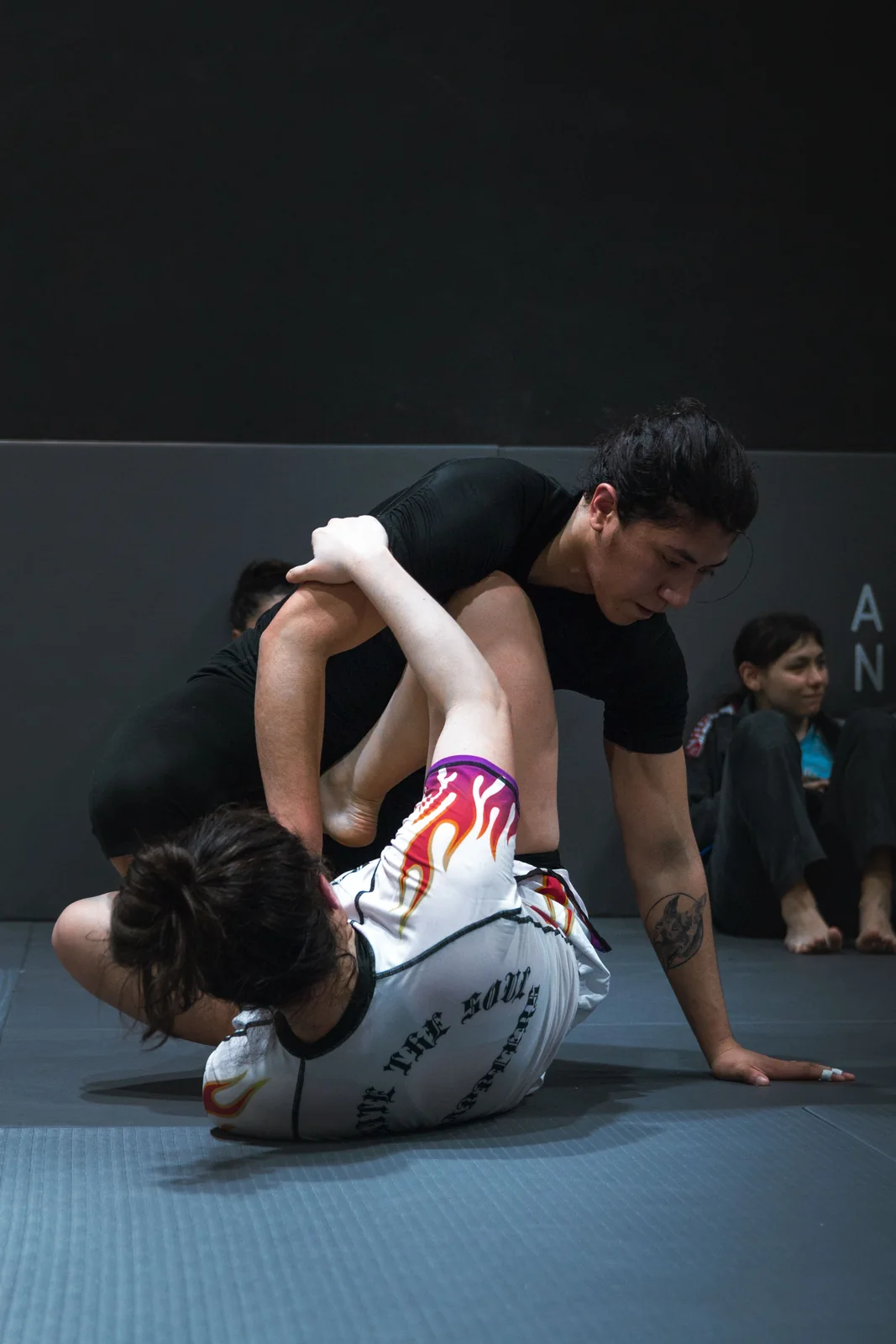
A problem on the ground may have started while the fighters were still standing. Return to that earlier moment.
Grappling
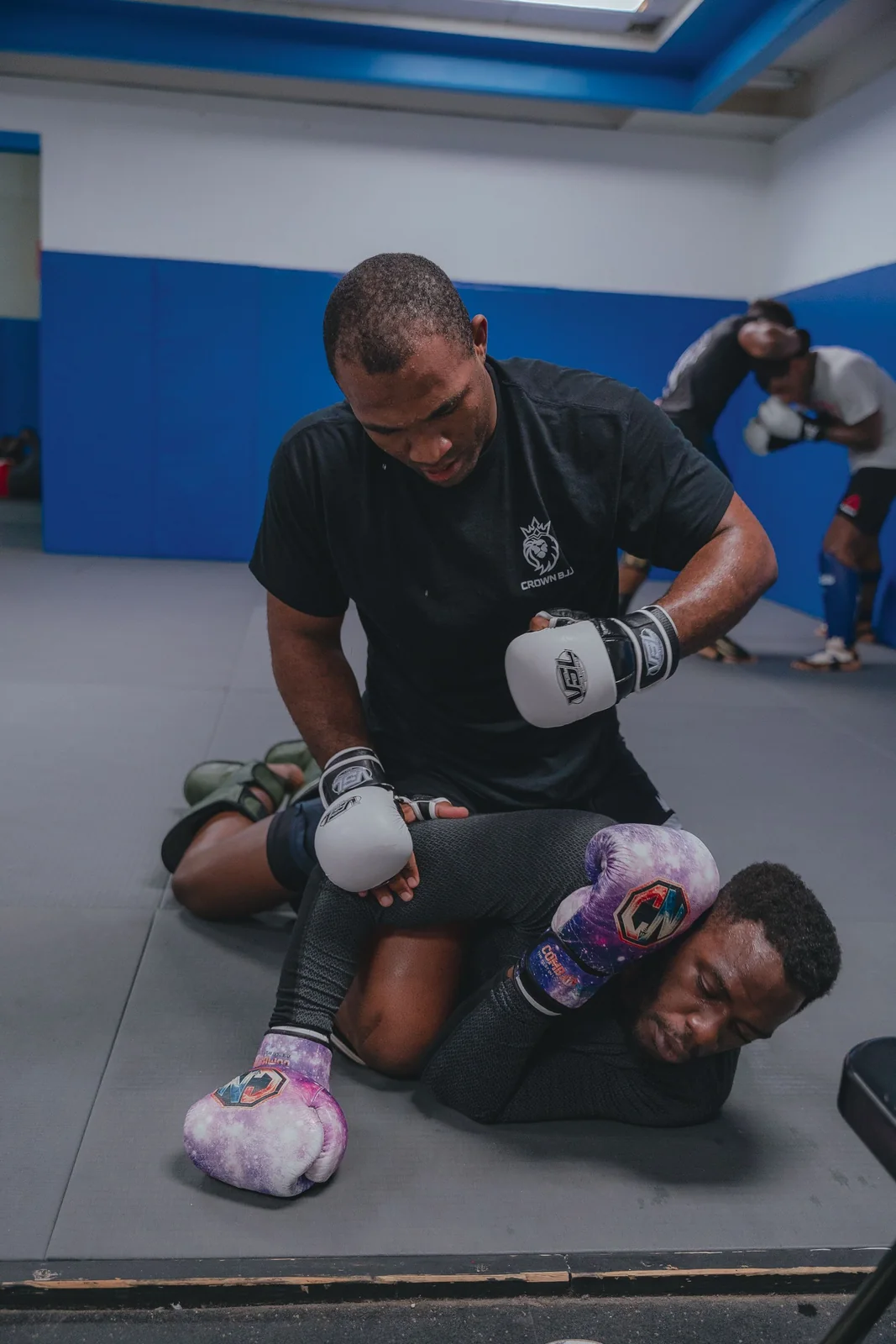
Holding someone close may still leave them room to punch. Ground & Pound makes that remaining space matter.